In the global race toward decarbonization, the demand for reliable energy storage has led to a proliferation of competing hardware options. For installers, distributors, and energy solution providers, the challenge is no longer just finding a battery, but determining which specific technology offers the best balance of safety, longevity, and return on investment. As we evaluate the landscape of solar battery storage systems, the debate often centers on chemical composition, voltage architecture, and intelligence. For B2B stakeholders, the stakes are high; a poor technological choice leads to high RMA rates and compromised safety. Among the industry leaders, HYXI has set a benchmark by championing high-voltage Lithium Iron Phosphate (LFP) technology as a leading choice for modern energy ecosystems.
The Contenders: Comparing Battery Chemistries
To understand which technology wins, we must compare the three dominant chemistries currently found in the market: Lead-Acid, Lithium NMC (Nickel Manganese Cobalt), and Lithium LFP (Lithium Iron Phosphate).
Lead-Acid: Once the industry standard, Lead-Acid is now largely obsolete for modern solar battery storage systems due to its low Depth of Discharge (DoD) of approximately 50% and a short cycle life of 500–1,000 cycles.
Lithium NMC: Known for high energy density, NMC batteries are common in electric vehicles. However, they pose a higher risk of “thermal runaway” if punctured or overheated, making them less ideal for indoor residential installations.
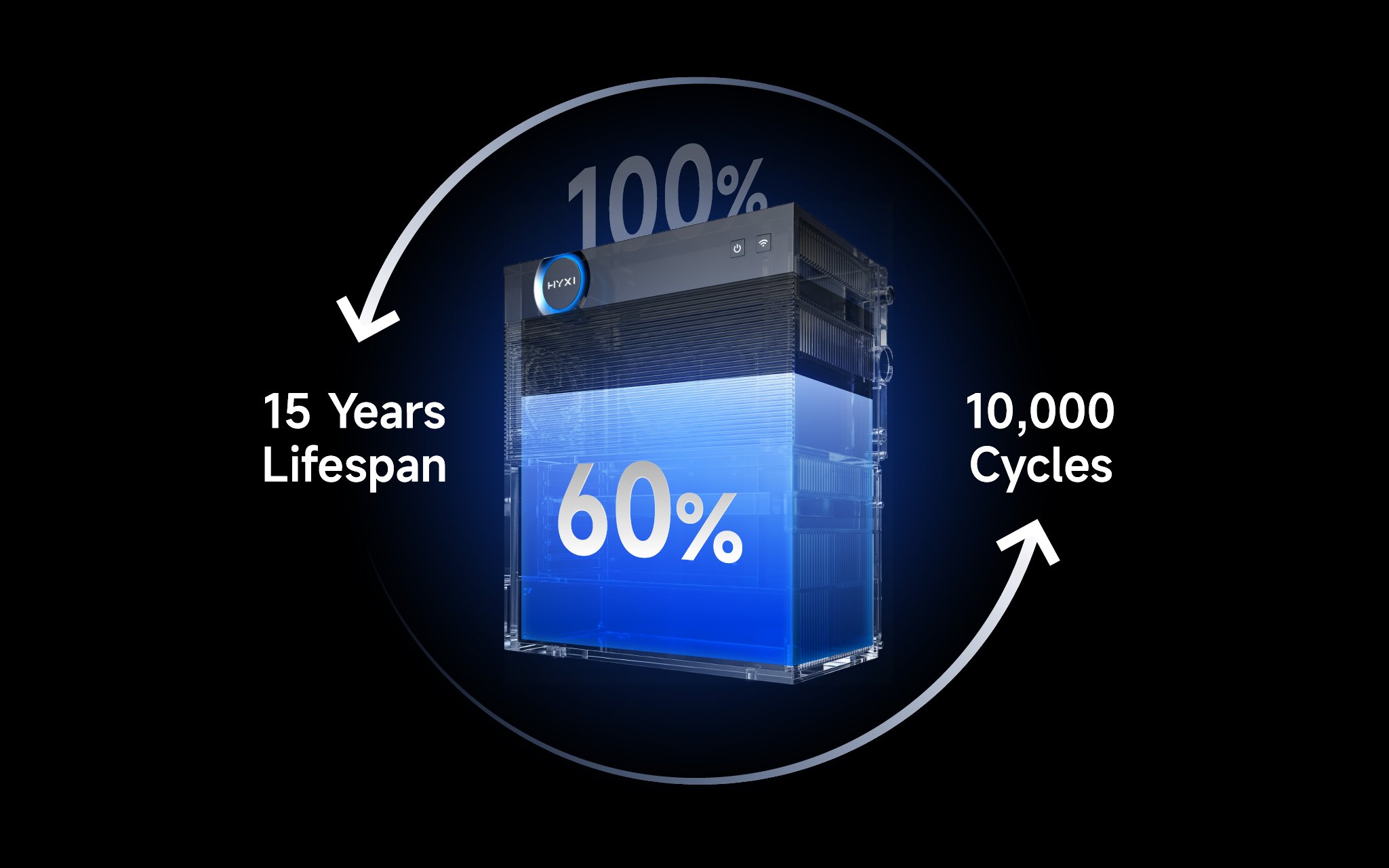
Lithium LFP: This technology has emerged as the clear winner for stationary storage. LFP batteries, such as those utilized in the HYXI HYX-B-HV series, offer superior thermal stability, a longer cycle life (10,000+ cycles), and contain no cobalt, making them more environmentally sustainable and ethically sourced.
Why High-Voltage (HV) Architecture Wins the Efficiency Race
Beyond chemistry, the architecture of the system—specifically the voltage—is a critical factor for energy solution providers. Traditional low-voltage (48V) systems are still prevalent but suffer from significant conversion losses and require thick, expensive copper cabling to handle high currents.
HYXI specializes in high-voltage solar battery storage systems. By increasing the voltage of the battery stack (often reaching 200V–400V+ depending on the number of modules), the system can achieve a round-trip efficiency of over 95%. For a distributor, this efficiency is a powerful selling point. It means that more of the energy harvested by the PV panels actually reaches the customer’s appliances, rather than being dissipated as heat during the DC-to-AC conversion process. Furthermore, high-voltage systems are easier to install, utilizing thinner wires and standardized connectors that reduce labor time on-site.
Longevity and Reliability: The 10,000-Cycle Benchmark
For a B2B project, the “winning” technology must be one that minimizes long-term maintenance costs. A battery that needs replacement after five years is a liability. HYXI’s LFP modules are rated for over 10,000 cycles at 90% Depth of Discharge. To put this in perspective for an installer: even if the battery is fully cycled every single day, it will still retain over 80% of its original capacity after 16 years of service.
This longevity is supported by an integrated, automotive-grade Battery Management System (BMS). The HYXI BMS monitors cell-level voltage, current, and temperature in real-time. If a single cell deviates from the safety parameters, the system can isolate the module or adjust the charge/discharge rate to prevent damage. This “active” management is what separates a professional-grade solar battery storage system from generic alternatives.
Safety: The Non-Negotiable Factor
In the residential and commercial sectors, safety is the primary concern for building inspectors and insurance companies. HYXI’s commitment to safety is reflected in their “Super Five” service concept, where “Super Reliability” is a core pillar. Their battery modules are IP65-rated, ensuring protection against dust and water, and have passed rigorous international safety tests, including UN38.3 and CE certification. Because LFP chemistry is inherently non-flammable and stable up to high temperatures, it provides a “peace of mind” factor that installers can use to differentiate their service in a crowded market.
Intelligence: The Role of Digital Integration
In 2026, the physical battery is only half of the solution; the digital ecosystem is the other. A winning solar battery storage system must be “smart.” HYXI utilizes iMesh-powered Sub-1G communication for its storage systems, offering a transmission range of up to 1,500 meters.
This connectivity allows for:
Remote IV Diagnostics: Enabling technicians to troubleshoot systems without a site visit.
OTA (Over-The-Air) Updates: Ensuring that the battery’s software is always optimized for the latest grid codes.
Peak Shaving and Time-of-Use Optimization: Allowing energy solution providers to program the system to discharge when electricity prices are highest, maximizing the financial “payoff” for the end-user.
Scalability: A Win for Distributors
From a business operations perspective, the “winning” technology must be scalable. The HYXI HYX-B-HV series features a modular, stackable design. Each module provides 5.12kWh of energy. For a distributor, this is an ideal inventory model. Instead of stocking ten different battery sizes, they can stock a single module type and stack them to meet any capacity requirement from 10kWh to 25kWh+. This modularity reduces warehouse overhead and allows installers to easily upgrade a customer’s system in the future as their energy needs grow.
Conclusion: The HYXI Verdict
When comparing modern storage technologies, the combination of Lithium Iron Phosphate chemistry and high-voltage architecture is the undisputed champion. It offers the highest safety profile, the best efficiency, and the longest operational lifespan.
For installers, distributors, and energy solution providers, partnering with HYXI ensures access to this winning technology. Supported by a global network of 12 Technical Assistance Centers and a “Super Five” service framework, HYXI provides more than just hardware; they provide a future-proof energy asset. As the world moves toward decentralized, smart grids, those who deploy solar battery storage systems built on LFP and high-voltage intelligence will be the leaders of the renewable energy revolution.

